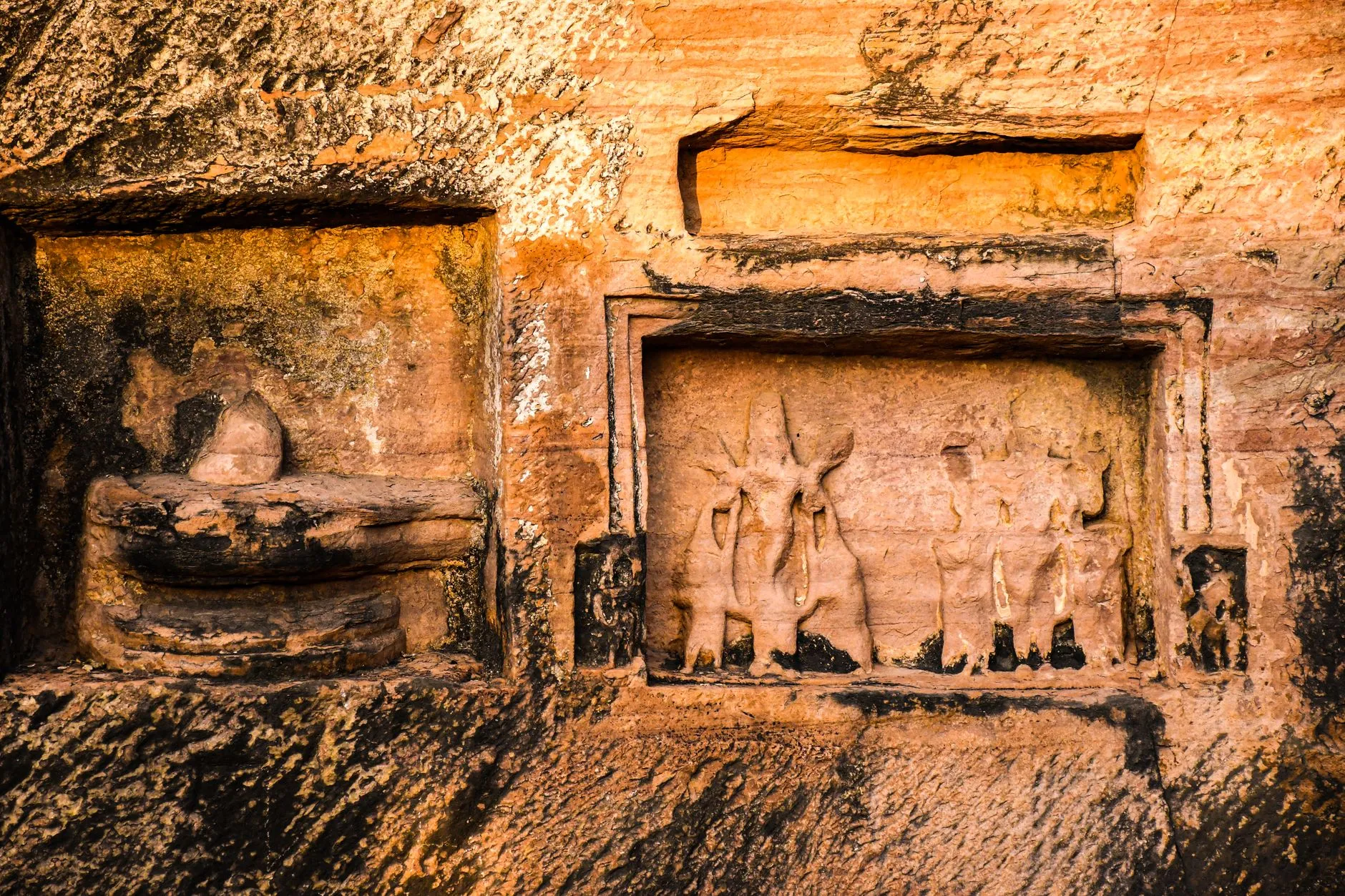
Dated inscriptions, a corpus of hundreds more, and a prehistoric record running back tens of thousands of years, all of it in the ground before Rome or the Arab conquest.
The case for an old Amazigh presence in North Africa does not depend on anyone believing a story about it. Much of it is physical: cut into stone, catalogued in museums, dated in laboratories. This page is the material record, and the rule it follows is the rule for the whole site, which is that each claim says what object it rests on and where that object is.
The stone that dates itself
In 139 BCE the notables of Thugga, the town now called Dougga in northern Tunisia, dedicated a sanctuary to the memory of the Numidian king Massinissa, who had died some nine years earlier. They recorded it on stone in two scripts: Punic and Libyan, the Libyco-Berber alphabet from which Tifinagh descends (Dougga 139 BCE).
What makes this one stone matter more than a hundred others is that it dates itself. The text is pinned to the tenth year of the reign of Micipsa, Massinissa’s son and successor, which converts to 139 BCE. No archaeologist had to estimate it from the style of the letters or the layer it was found in. The people who cut it wrote down when.
It was excavated in 1904 under Paul Gauckler’s direction, published the same year by Philippe Berger, and it is in the Bardo National Museum in Tunis (Dougga 139 BCE).
The other Dougga bilingual, and why the confusion matters
There is a second Libyco-Punic bilingual from Dougga, and it is the one most people have actually seen. It came from the Mausoleum of Ateban, and in 1842 the British consul Thomas Reade had the inscribed frieze prised out of the monument, damaging it, and shipped to London. It is in the British Museum (Ateban, 2nd c. BCE).
That inscription names the monument’s architect and head artisans. It names no king and it carries no internal date.
The two are confused constantly, including in careful places, and this site got it wrong in its own first draft: the entry for the dated temple inscription originally listed the British Museum as its home. Both objects are real, both are from Dougga, and only one of them tells you what year it is. Keeping them apart is the difference between a sourced claim and a plausible one.
Not one inscription, a corpus
A single dated stone is an artifact. What makes it a writing tradition is how many others there are.
The standard corpus is Jean-Baptiste Chabot’s Recueil des inscriptions libyques, universally cited as RIL, whose first fascicule alone collects 917 texts with transcriptions and plates, against the 350 that had been published before it (RIL 1940). These are scattered across what were Numidia and Mauretania and on into the Sahara: funerary stones, dedications, short rock-cut texts.
Most are undated and many are short. That is normal for an epigraphic corpus and it is not a weakness in the argument. The Dougga stone supplies the calendar date; RIL supplies the scale.
Taforalt: a cemetery, not just a genome
The Grotte des Pigeons at Taforalt in eastern Morocco is best known now for producing the oldest sequenced human genomes in Africa, which are treated on the genetics pillar. It was an archaeological site long before it was a genetic one, and the archaeology says something the DNA cannot.
Excavations in 2005 and 2006 opened an undisturbed burial area at the back of the cave and found four closely spaced, inter-cutting graves. Three of the four adults had been placed seated or slightly reclining, facing the cave entrance; the fourth lay highly flexed on its left side. Earlier burials had been cut into by later ones, with displaced bones incorporated into the newer graves (Humphrey et al. 2012).
The authors describe Taforalt as possibly the earliest and most extensively used prehistoric cemetery in North Africa (Humphrey et al. 2012). The chronology of the sequence rests on an AMS radiocarbon programme on the Middle and Later Stone Age deposits (Barton et al. 2013).
Read what that actually describes. Not a body in a hole, but a place people returned to over generations, with a shared idea of how a person should be positioned in death, maintained long enough that the graves began running into each other. That is a community with a practice, in the Maghreb, in the Pleistocene.
The deepest layer, and what it does not mean
North Africa’s archaeological record runs much further back than any of this, and the most striking site is Jebel Irhoud in Morocco, which produced hominin fossils argued to sit near the root of the Homo sapiens lineage (Hublin et al. 2017). Thermoluminescence dating of heated flints found with them gives 315 ± 34 thousand years ago, supported by an electron spin resonance age of 286 ± 32 thousand years on a tooth from one individual (Richter et al. 2017).
This is not evidence about the Amazigh, and it is important to say so plainly. Three hundred thousand years is far outside the range of any meaningful claim about a people or a language. No population, no ethnic identity and no linguistic group has that kind of continuity, anywhere on Earth, and anyone who tells you otherwise about any group is not doing history.
It is here for one reason: it establishes that North Africa is not a periphery that humans arrived at late. It has been occupied for essentially as long as our species has existed. What happened in the last few thousand years of that occupation is a separate question, answered by different evidence, on the other pages of this site.
Where to go next
The script this corpus is written in, its place in the Afroasiatic family, and its encoding in Unicode are in The Language & Its Script. What the Taforalt genomes do and do not show is in Blood & Continuity.
Every citation on this page was checked against the original source, with one exception that is labelled as such: the British Museum accession number for the Ateban frieze could not be verified, because the museum’s collection record returns a bot challenge. What was checked, and what was not, is recorded in each entry in the bibliography.
Last updated October 26, 2026 · View all sources · How this site is sourced